The mural painting group “Brigadas Ramona Parra”, founded in 1969 by young communists, took its name from that of a textile worker murdered in Bulnes Square in the centre of the Chilean capital in 1947. Within a few years, all Unidad Popular parties had their own Brigadas.
From 1970, with the presidential campaign in which Salvador Allende was elected president of the Republic, mural painting became a political and cultural phenomenon that attracted worldwide attention.
The phenomenon began with the election campaign of 1964. Salvador Allende and his supporters faced the situation with little money, unlike their opponents, led by Eduardo Frei Montalva, who had excellent financial resources and counted on the support of journalists, sociologists and psychologists specialised in communication strategies. Support for Frei was impeccably structured and strengthened by the use of highly effective slogans, devised by experts who left nothing to chance and also relied on propaganda in the streets, having the so-called stars of Frei made on the walls of huge dimensions.
Allende's supporters were caught off guard but tried to align themselves with their opponents' methodology and began a veritable pictorial offensive in the streets, going out in their thousands to paint even all night long.
The material they used consisted of ten sacks of carbon black, carpenter's glue and a considerable amount of metal buckets, all donated by port workers and oil refinery workers. With this precious material, approximately two thousand litres of good quality black paint were prepared. The entire province of Valparaíso was thus filled with the famous painted 'X' of Allende's campaign. However, the action was not carried out judiciously and this led to mistakes such as painting on monuments and public places. The activists were thus accused of vandalism, making Allende's supporters totally vulnerable.
It was in this climate that the idea arose to look for new forms of propaganda, such as artistically representing popular slogans and aspirations in posters painted directly on walls. The idea had come to a painter from Valparaíso, who had sketched some sketches, awakening enthusiasm. In a single night, two painters and a group of young helpers painted the wall on Avenida España, the strategic artery linking Valparaíso and Viña del Mar. This was the first political mural painted in Chile, which was soon followed by another, also along the same street, even longer and closer to the city centre. This painting had a strong impact on the population and provoked an immediate reaction from the Partido de la Democracia Cristiana, who, with the help of some propaganda professionals, had a huge mural painted with Frei's star and the slogan “fifty thousand scholarships for poor children”. In response, the next evening, Allende's muralist group painted next to the star the slogan “in the popular government there will be no poor children”. The “propaganda battle of Avenida España” began. Youth groups took part in it, covering the thoroughfare with Salvador Allende's “X”s', colouring them in the colours of the national flag, for a great visual and propaganda impact.
Pablo Neruda, who was then living in cerro Bellavista, expressed his interest and enthusiasm, calling the initiative “a beautiful polychromatic action”. Salvador Allende qualified the mural movement as one of the most remarkable initiatives of his campaign. From that moment on, mural painting became a mass national artistic phenomenon and reached its peak in the 1970 election campaign, subsequently giving rise to muralism as a collective and artistic form. After Salvador Allende's triumph, the watchword was “we won, let's go ahead and build a new Chile!”
The Brigadas Ramona Parra produced a great artistic change and brought muralism into the streets, under the open sky, to visually inform the viewer and educate them through social denunciation. Matta went to Santiago in 1970 to paint a mural in the municipal swimming pool of La Granja, a popular municipality on the outskirts of the city, together with the Brigada Ramona Parra. Today, that mural, which the dictatorship erased, or rather tried to erase fifteen times, has been restored and is now part of Chile's cultural heritage, a source of study and university research.
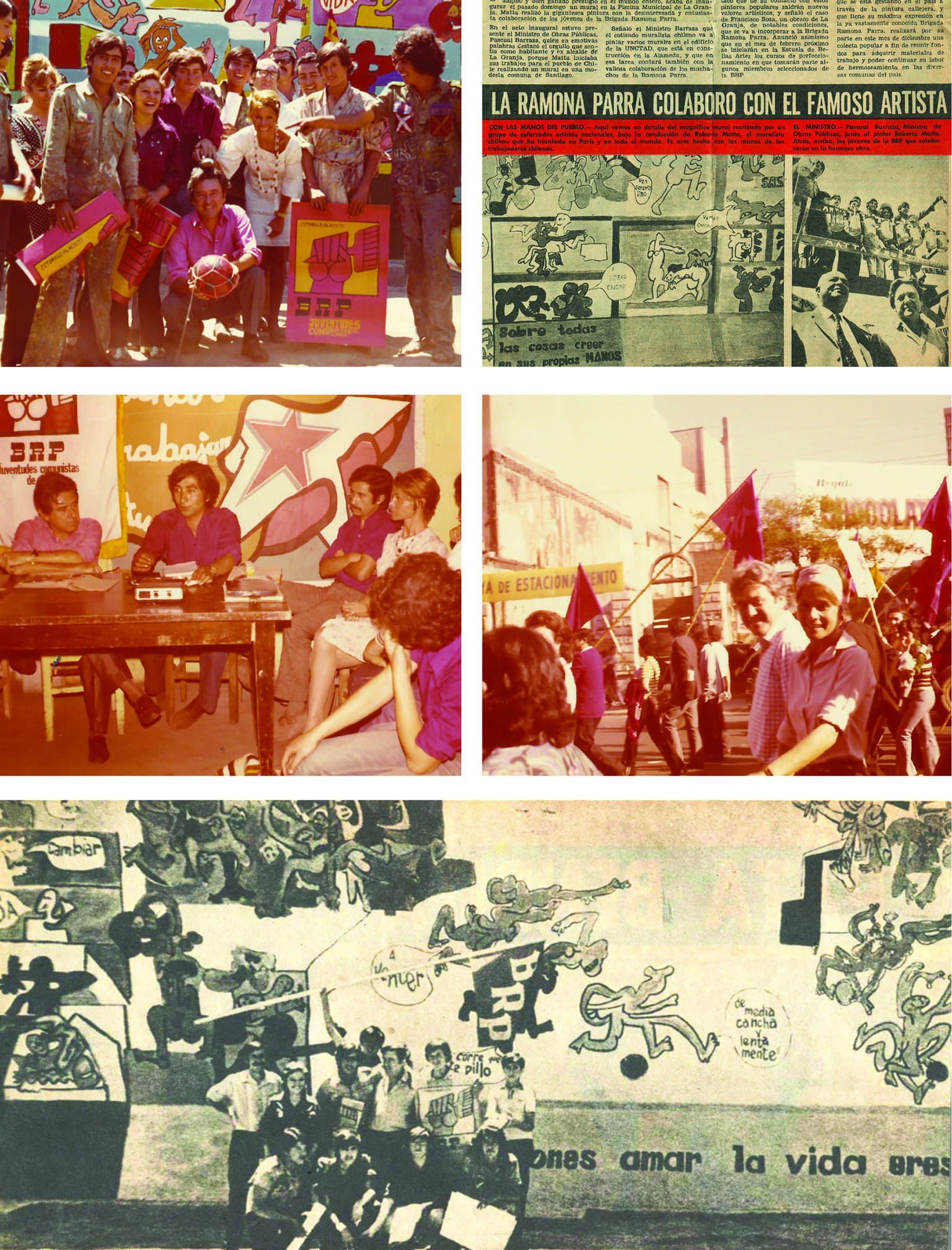 Matta with the Ramona Parra Brigade, Chile, 1971