“I often react like a journalist to current events. People say I am a political painter and committed. I don't realise it, my subjects are in life, I want to talk about an event that upsets me.”
Gallery Jardin des Arts No. 151 October 1975.
In February 1975, the Museum of Modern Art in Mexico City, in collaboration with the museums of Bogota and Caracas, presented some twenty canvases painted in the last ten years, including for the first time: Le Grand Burundùn, a series of six large paintings of twenty metres in length illustrating the story of Caballazo, already told by the great Colombian poet, Jorge Zamalea, who died in 1969.
“The army was so terrified that it fled. Then everyone fled: the powerful and the humble, those who had weapons and those who had none, the old and the young, the intelligent and the naive: swept away like rubbish on the wave, like rubbish in the gale, like the ashes of the hearth, towards a lower and lower horizon of fog and drizzle, towards the deserted countryside where there was not there wasn't even a dog barking. In the black cage of the coffin, under the icy sigh of that last twilight, the great Newspaper Parrot seemed to hiss like an asthmatic. Then the horse rose again on its hind legs...”
Jorge Zalamea. The great Burundun-Burunda died, translated from the Spanish by Francis de Miomandre, Seghers, 1954.
After the coup d'état in Chile, Matta gradually abandoned political causes to devote himself to the Greek and pacific myths. In May, he exhibited large pastels and a small retrospective of coloured drawings: L'Homme descende du signe - the catalogue with a text by Giuliano Briganti.
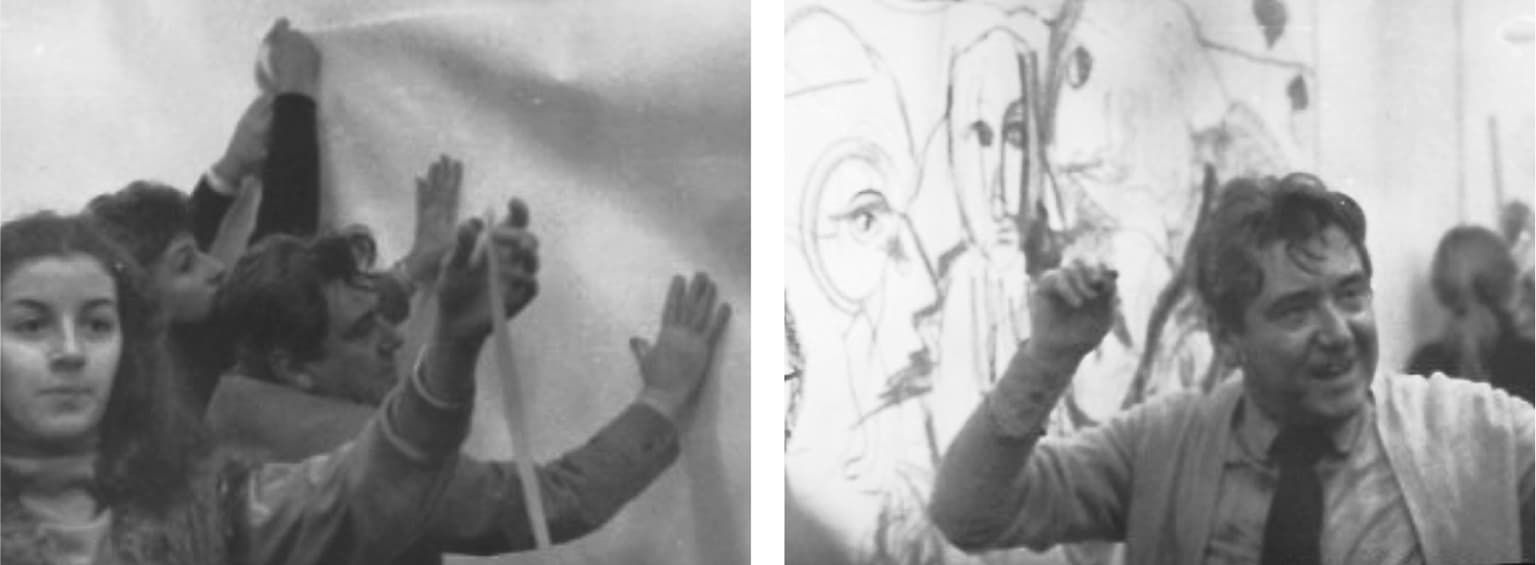 Cambridge University
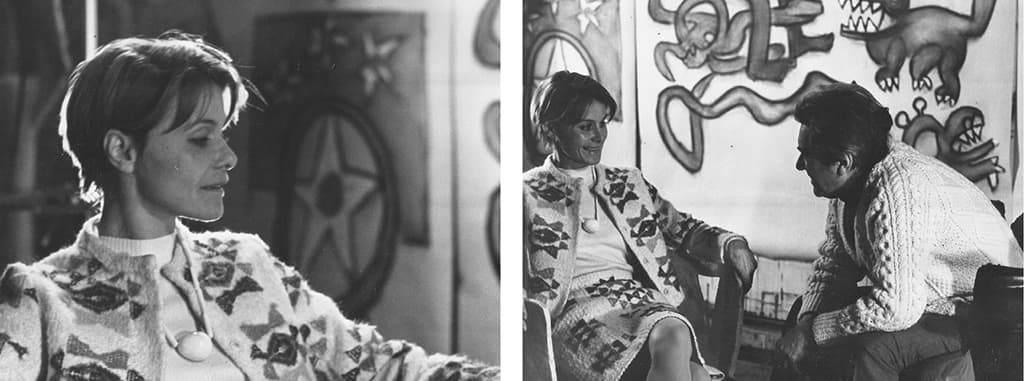 Matta and Germana at La Bandita, Tarquinia
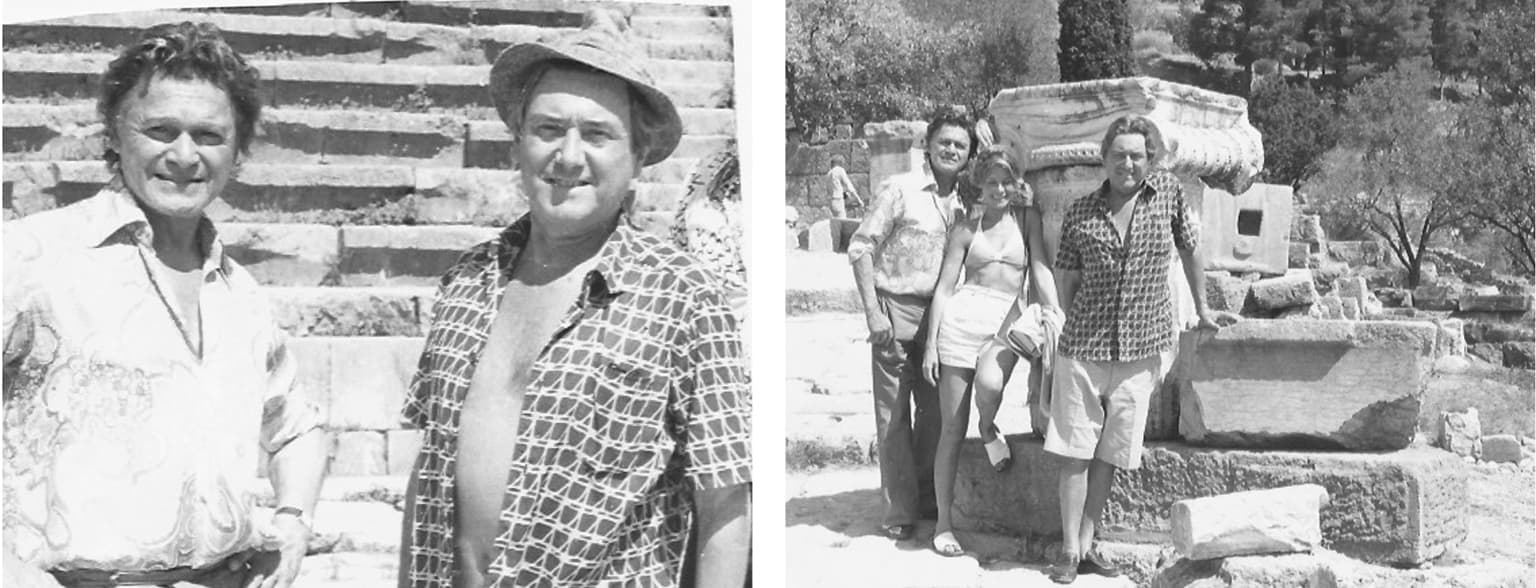 Matta with Alexander Iolas, Acropolis of Athens. August 1975
In February 1976, a new exhibition in Havana, at the Casa de las Americas, featuring almost all of his work as an engraver. Later, in July, in the castle of Castelnou, Matta paid homage to the Pyrenees, land of the Basques (the artist always felt more Basque than Chilean, French or Italian - in other words a Basque in exile).
He received a letter from George Lucas stating that his paintings inspired a scene from Star Wars. He finds an echo in the science fiction universe. He completes the construction of the Fiat Autoapocalipse with bodywork elements, work begun with a group of workers and craftsmen from Tarquinia in 1973.
“A house entirely equipped with bedroom, boudoir, bathroom, made with elements taken from the bodywork of a Fiat. Autoapocalipse in the sense of apocalypse is catastrophe, cataclysm, disaster, but at the same time, revelation. Revelation is discovering that this disaster, the car, can be avoided with the discovery of a new life project...
Autoapocalipse is a home for living”.
Autoapocalipse travelled to Naples, Bologna, La Spezia, Terni, Florence and Prato, and was published in 1980 in a book by Renato Nicolai. In the same period, Matta participated in two important group exhibitions: “Paris-New-York”, at the Musée National d'Art Moderne in Paris, and “VI Documenta” in Kassel, in the section “Reality, Hyperreality, Unreality”, where he exhibited five recent drawings.
In September of that year, the Hayward Gallery in London organised the exhibition “Coigitum”, in which seven of his large paintings were included.
He executed a series of lithographs for the book L'Auricana by Alonso de Ercilla, written in 1500.
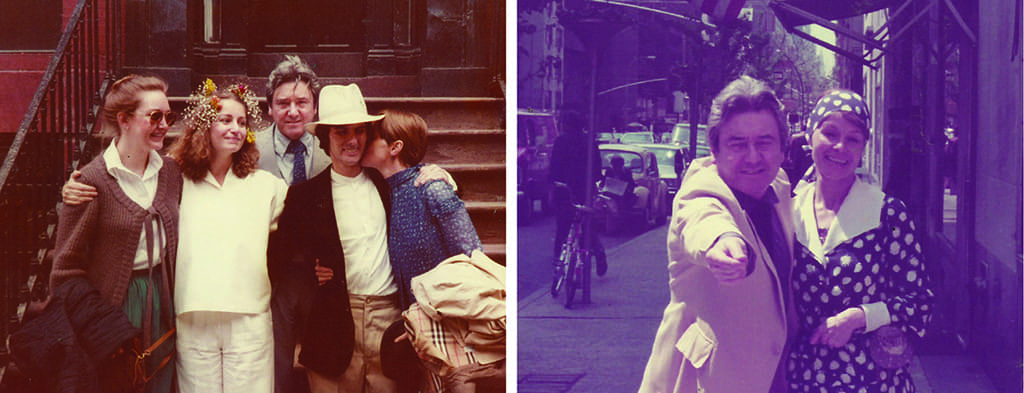 Gordon's wedding, New York, 1978
On the occasion of the exhibition Il cuore è un occhio at the Palazzo degli Alessandri in Viterbo, presentation of Germana Ferrari's book, Indice dell'opera incisa 1969-1980 with many unpublished texts. In November, he participated in the 9th Lille Festival on the theme Science in the Future-Fantasy, with the triptych triptych: Eros Ocean.
On 11 June, he married Germana Ferrari in London.
In 1981, an exhibition of his engravings, pastels and about ten paintings was held at the Palazzo Reale in Naples, ten or so paintings, Odisseano si è fermato a Napoli. He took part in Havana, in the Meeting of Intellectuals for the sovereignty of the peoples of our America. He illustrates with giant pastels the first book of Garganta. In the same year, Matta took part in two important group exhibitions: A New Spring in Painting, at the Royal Academy in London, and Paris-Paris, at the Musée National d'Art Moderne in Paris.
New exhibitions at the Theatre d'Ivry, Architecture du temps, and in Rome, at the L'Attico Gallery. Matta supports the project to establish the “Museo del arte del hombre latino-africano” in Cuba with the donation of a series of his sculptures.
He takes part in the 'Congress for the Cultural Autonomy of Our America' in Managua, Nicaragua. Donates a project for a monument to the UNEP (United Nations Environment Program) in Nairobi, which will emit waves close to solar energy. In the same year, an exhibition of his works opens in Berlin, at the Onnasch Galerie. For the occasion, the artist composed a short poem in English.
He illustrated eight etchings of Alfred Jarry's Ubu-Roi for Dupont-Visat.
In January 1983 he presented a series of large-scale etchings and pastels at the Riverside Studio in London inspired by Shakespeare's The Tempest, which Matta compares with the epic of pre-Columbian America. He became increasingly interested in Pacific cultures.
Between November and December of that year, the Museums of Valencia and Barcelona organized a large retrospective entitled “Mediterranean, Verb America”.
“America is not only a continent, a space, but also time. If space is matter, the noun, the verb, becomes energy, is time. The Mediterranean is, in the end, a magnetic field and the same things happened, depending on circumstances, in the Mediterranean and in America. The Mediterranean is Europe, Africa, Asia”.
Maria Luisa Borràs, interview in Mediterraneo, Verbo America, 1983
A series of drawings on Don Quixote begins.
In February 1984, the Piazza Maggiore Association of Todi exhibited, at the Palazzo del Popolo, the two large paintings (10 metres long), Coigitum and Speculum oraculi. In May, he exhibited a series of pastels from 1983, El Verbo America, at the Museo de Bellas Artes in Havana.
“Verbal America is conjugating past participles with conditional present tense, it is reorganising all the gaps in the narratives: the tales of the Mediterranean Indian with those of the natives of America and the Pacific, it is taking all the fingers that come together, instead of despising them with megatons megalomaniacs”In June, the Samy Kinge Gallery hosts the exhibition Matta: Point of Support. The Arts Council of London is organising a touring exhibition entitled Matta - The Logic of Hallucination. His son Ramuntcho introduces him to computer tools and, at the initiative of Christian Jannicot, produces a dozen one- to four-minute films for Canal+ called “Paint Boxes” that explore the possibilities of the graphic palette.